
Part I: Who Gets Rich Off Our Joy?
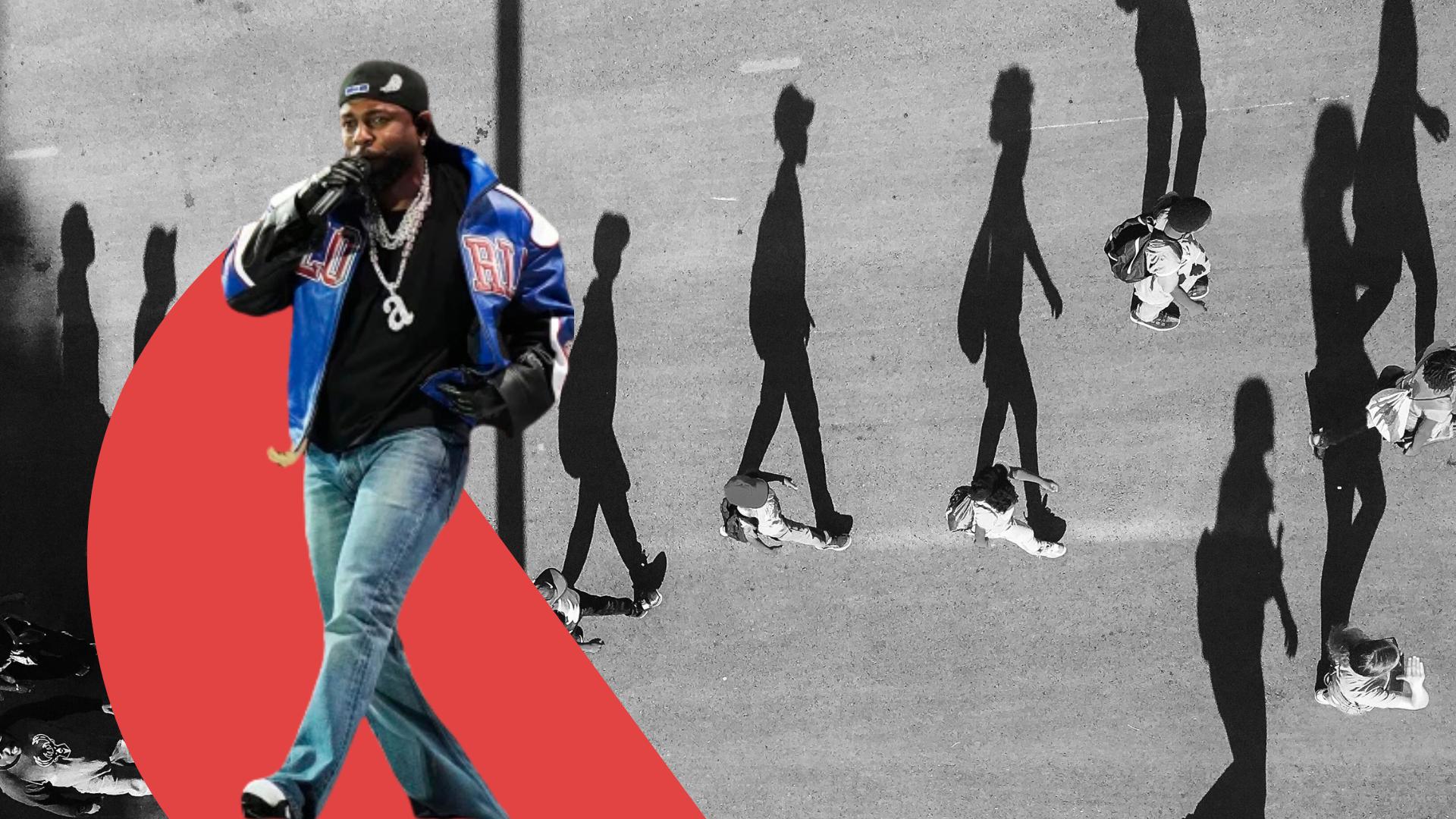
Kendrick Lamar’s artistry is an invitation to collective economic liberation—through lyrics, visuals, and business moves that uplift financial know-how, ownership, and reparations.
But liberation can’t rely on spectacle alone. As Kendrick’s star rises, so too does the profit of corporations and industries that extract wealth from Black culture. Who actually benefits from his message?
In early 2025, Kendrick Lamar seized the world’s biggest stage: the Super Bowl halftime show. Nearly six months later, we’re reflecting on how a stage typically used to market products, was instead turned into a fiery sermon on Black history and economic justice. The stage itself was built like a giant video game, with platforms shaped as PlayStation controller buttons and a chain-link prison yard stretching across the field. On the jumbotron, phrases like “WARNING: WRONG WAY” flashed like we were inside Grand Theft Auto: American Empire, while Kendrick’s dancers formed a living U.S. flag that he literally split down the middle. Legendary actor Samuel L. Jackson topped off the theme by appearing as Uncle Sam, complete with star-spangled top hat and tails.
Subtle, this was not.
It was a visual indictment of how America plays its “great game” with Black lives—from slavery to mass incarceration—all unfolding in prime time. Kendrick’s art has always delivered radical messages about Black wealth, trauma, and resistance. But here he dialed it up to mass spectacle. At one climactic moment, Kendrick stared into the camera and rapped, “40 acres and a mule – this is bigger than the music.”
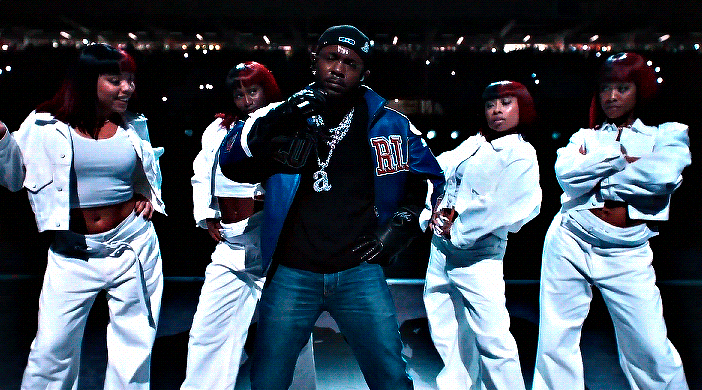
The reference was unmistakable: the Civil War–era promise to give freed slaves 40 acres and a mule, a promise America never kept. As one reviewer noted, that statement set the tone that Kendrick was “there for something much bigger than halftime entertainment.” Indeed, Kendrick’s halftime performance was essentially a protest piece beamed out to 133.5 million viewers, complete with chain-gang choreography and pointed lyrics about reparations. It felt like a televised revolution. And yet, and here’s the irony, even as Kendrick advocates for reparative values, the spectacle itself feeds the very systems he’s critiquing.
The NFL (not exactly known for progressive leadership) got a PR boost; the sponsor (Apple Music) got its brand splashed across a “woke” moment; viewership and social media engagement skyrocketed, lining the pockets of network execs and tech platforms. Kendrick lit up the stage with a vision of Black liberation, but who actually profits from that message?
“What does reparative finance look like when the culture itself is the commodity? This paradox set the stage (literally) for a deeper conversation.”
Kendrick’s Long Conversation with Capital
Kendrick Lamar has been having a running dialogue about money from his very first album. Unlike many artists who treat money purely as a flex, Kendrick consistently connects wealth to systemic trauma and Black survival. He raps about cash the way Moby Dick rants about the whale—as obsession, metaphor, mirror, and motivator all in one.
Rewind to 2012’s good kid, m.A.A.d city: on “Money Trees,” a young Kendrick paints the hunger of growing up in poverty and the tantalizing dream of getting rich. “Money trees is the perfect place for shade”, he muses in a cynical quip about how a little money could ease the brutal heat of hard times. The song is both a come-up anthem and a poignant reflection on the ways money impacts our lives and communities, and a call to action for greater economic justice and equity.
In other words, Kendrick wasn’t just chasing the cash. He was questioning what the chase was doing to us. Fast forward through his discography and you’ll find a long trail of receipts. On To Pimp a Butterfly, he opens with “Wesley’s Theory,” satirizing how record labels, and Uncle Sam alike, prey on Black talent “Uncle Sam make you fooled,” he jabs, referencing Wesley Snipes’ tax woes. He wrestles with the moral cost of fortune on “How Much a Dollar Cost,” where denying a homeless man a single buck turns out to cost him his soul.
By the time we reach Mr. Morale & the Big Steppers (2022), Kendrick is literally airing out generational trauma and financial stress in therapy-like tracks. He bluntly admits “I grieve different.” Splurging on luxury goods to cope with pain, yet, only to conclude it’s a hollow substitute for healing.
Over a decade of music, Kendrick’s been schooling listeners that wealth is never just personal in a world of systemic scarcity and racial inequity. Money in his songs can be a weapon (“PYRAMIDS” he calls out fake empowerment schemes), a temptation, or a tool—but it’s always tied to context. He’s essentially asking: what good is personal wealth if your community stays broke? And conversely, what does survival look like when the system is rigged to keep you in the poorhouse? Kendrick’s conversation with capital is long, nuanced, and never just about getting paid.
The Grand National Tour: Minimalism, Localism, and Cultural Wealth
After that Super Bowl spectacle, you might expect Kendrick’s own concerts to be nothing but fireworks and extravagance. Yet his recent Grand National Tour (a 2025 stadium tour co-headlined with SZA) took a different tack—mixing blockbuster production with an almost theatrical intimacy. Sure, he sold out 50,000-seat venues and shattered revenue records (the opening show grossed a staggering $9 million, marking the highest-grossing hip-hop show ever). But instead of a generic big-budget pop show, Kendrick crafted an experience that emphasized connection and narrative over pure spectacle.
The tour was structured in acts, almost like a play, each with its own story arc and setting. Kendrick literally rolled onto stage in a modest 1980s Buick Grand National car—a nod to his Compton roots—rapping from the driver’s seat as if taking the audience for a ride through his neighborhood. Throughout the night, the stage morphed from Compton’s streets (with lowrider vibes and curbside lampposts) to moss-covered meadows out of SZA’s ethereal world. One minute you’d see a troupe of c-walking dancers repping West Coast culture; the next, Kendrick might strip things down to just a spotlight and spoken word, addressing the crowd like it was an intimate poetry slam.
Despite playing in massive arenas, Kendrick managed to localize the feel—honoring Black cultural specificity rather than presenting some watered-down spectacle. He brought out regional DJs to spin local anthems at intermission, shouted out historical landmarks in each city, and often highlighted Black joy and resilience in the visuals (from archival family videos to imagery of the Great Migration).
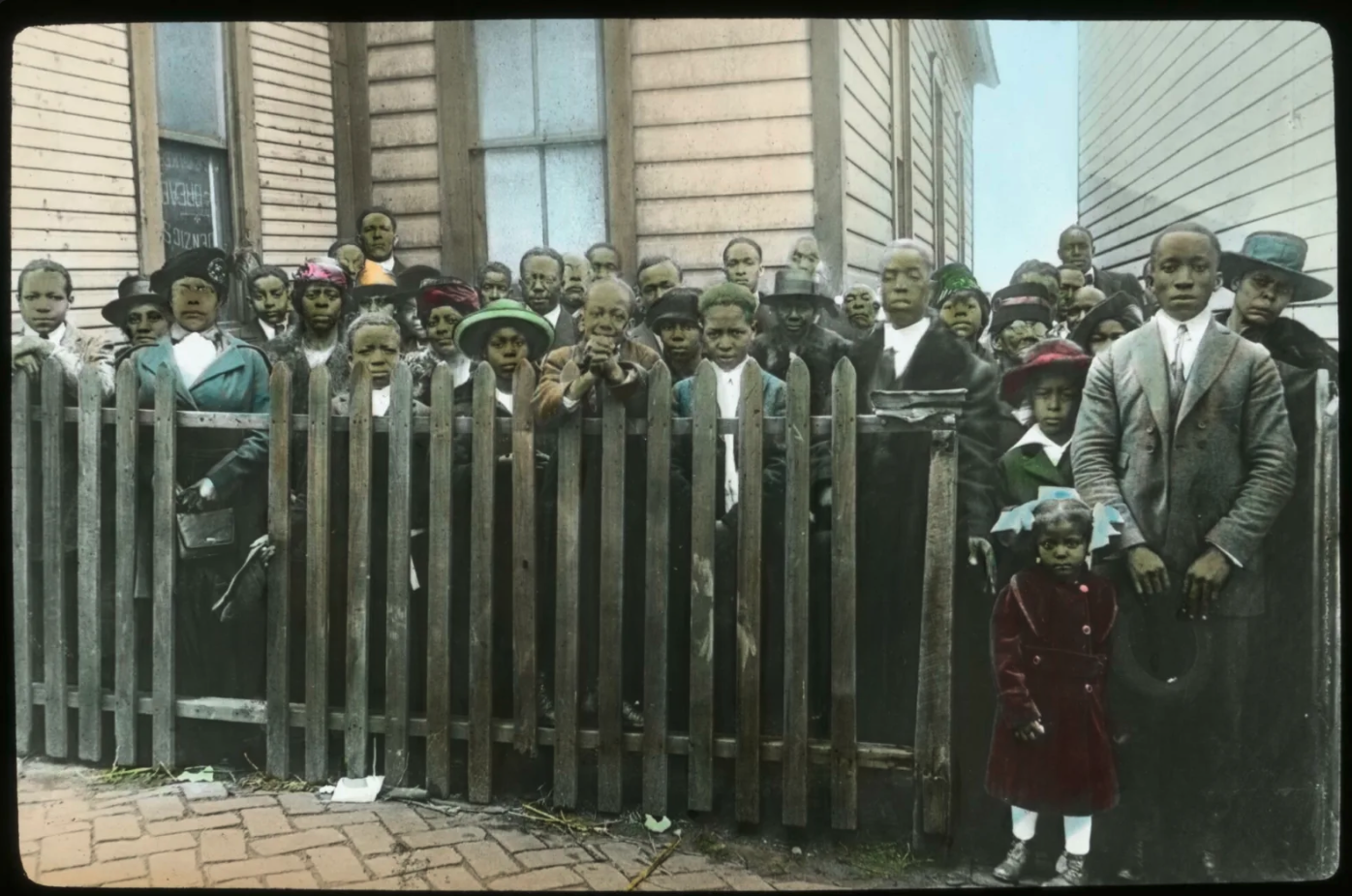
The setlist itself told a story, weaving old hits with new material and even unreleased tracks debuting live. With an intentional and deeply Black production, Kendrick was clearly putting a message over flash, even as he entertained. For all the high-tech screens and pyrotechnics, some of the most powerful moments were simple: Kendrick under a single streetlight rapping his heart out, or pausing the music to speak on what “family” means to him in Compton versus in the music industry. It was stadium-sized art with a hometown soul.
All this begs a tantalizing question: What if art wasn’t used just to entertain or inspire, but to circulate capital within communities? Kendrick’s show brought people together and uplifted cultural wealth; could it also directly uplift financial wealth for those communities? Imagine concert revenue looping back into the neighborhoods whose stories fuel the music. The Grand National Tour hinted at the power of culture on a grand scale. Now, how do we make sure the culture keepers (the people) share in the wealth it generates?
Reinvesting Joy: What Reparations in Culture Could Look Like
It’s time to get concrete. How might we imagine artist tours or viral moments outside of mere stockholder enrichment, but as opportunities to actually redistribute wealth in line with the message? What could real cultural reparations look like in practice? Let’s imagine a few possibilities:
Tour Revenue Sharing: Picture this—for every city a tour sells out, a portion of the profits is plowed into a local Black community investment fund. If the Grand National Tour grosses $9 million in one night, what if even 5% of that ($450k) stayed in Philadelphia or Atlanta or LA to seed Black-owned businesses or a community land trust? It could be structured as a “One City, One Fund” initiative: each stop, money goes to a grassroots fund managed by local community leaders. Essentially, turning a concert tour into a rolling economic stimulus for Black neighborhoods. (This isn’t far-fetched. Beyoncé, for example, has been doing something akin to this with her BeyGOOD foundation, awarding grants to small Black-owned businesses in each city on her tour.)
Ticket Surcharges for Mutual Aid: Imagine if every ticket to a show had a $1 or $5 “Joy Tax” – not a tax that goes to Uncle Sam, but a direct contribution to mutual aid and community projects. Concert-goers would essentially be donating to the cause as they buy their ticket. Say 50,000 people buy tickets; that’s an instant $50k into a fund for local housing cooperatives, youth arts programs, or emergency assistance for families. Fans would likely embrace it because they get to party at the show and know they’re investing in the community’s well-being. It’s like GoFundMe built into Ticketmaster (and frankly, we could use some good coming out of Ticketmaster for once).
Cooperative Brand Partnerships: Artists could negotiate sponsorship deals that include requirements to support cooperative economics. For instance, if pgLang does an ad campaign with a brand, stipulate that a chunk of that campaign’s budget must go to hiring Black-owned agencies, Black creatives, or funding a community project. Or design partnerships where the product itself benefits the community: imagine Kendrick endorsing a financial product where a portion of every transaction fee goes to a college fund for Black students or a microloan program for Black entrepreneurs. Essentially, any brand that wants the Kendrick Lamar stamp of approval has to give back in a real way, not just borrow the cool factor. This flips the script from extraction to reciprocity.
Community Control of Cultural Capital: Another radical idea—what if fans and community members could literally invest in Kendrick’s projects and share the returns? With all the talk of NFTs and tokenization, there might be a future where an album release comes with community shares, or a tour is partly crowd-funded by the people, who then get paid dividends. It might sound out-there, but it could align incentives: if Kendrick’s art succeeds, the community that backed him financially sees a direct benefit. This is cooperative economics 101, applied to pop culture.
Institutional Alliances for Reparations: Artists can team up with philanthropic boards and institutional investors (some of you reading this fit that bill) to channel funds into what RUNWAY Roots calls reparative capital frameworks. That could mean creating an endowment that grows over time and funnels money into Black-owned community banks, or supporting policy campaigns for things like baby bonds or student debt cancellation for marginalized groups.
Kendrick’s message amplifies the why; wealth holders can supply the how. The point is to root capital in repair: loans and investments that prioritize those who’ve been excluded, structures that give power to the people normally left voiceless in budgeting decisions. Some of these ideas are already budding in the real world. We see hints of it when artists fund scholarships, or when entertainers like Rihanna build schools and superstar athletes like LeBron James build community centers. We see it when Beyoncé’s foundation injects $100k into local entrepreneurs city by city. These are reparative moves, even if they’re not labeled as such.
The challenge is to take these one-off good deeds and bake them into the very business model of culture. Cultural capital must be reinvested where it came from. Our joy (the songs, the style, the vernacular, the vibe) has immense economic value. It’s only right that those who generate that joy, often under the harshest conditions, share in the gains.
